Christmas on Iceland
Christmas is a blend of Christianity and older traditions. It celebrates both the birth of Jesus and the winter solstice and other rituals; it is about light and darkness. The celebrations are magically intertwined, and thanks to our ancestors, we get through these dark winter days just fine. For instance, it makes perfect psychological sense to bring a green tree into the house, with all the bare trees outside. The lights are also good for the psyche, enhanced by reflective Christmas ornaments. Moreover, there are rituals to entertain us—dining with family, midnight mass, the gifts, and even the games involving scaring and teaching children.
With Sinterklaas and Christmas, the festivities in the Netherlands are spread throughout December. In other countries, the two are intertwined and presents are placed under the Christmas tree. In Iceland, it’s even more magical. There, they’ve arranged things so that Christmas, just like the pitch-black days, lasts a long time. There, Christmas is intertwined with an ancient legend.
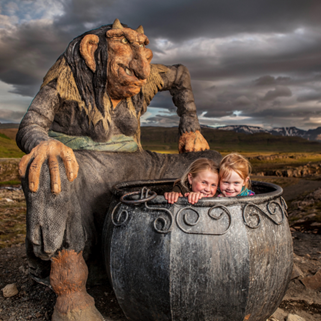
In the rugged mountains of Iceland lives a terrifying couple: the giantess Grýla and her husband. Grýla has a huge appetite. In December, she comes down and carries naughty children off in a sack to satisfy her hunger in a cave. Then there are the Yule Lads, her 13 mischievous sons. They too cause a stir in people’s homes and get up to all sorts of mischief. They also visit the inhabited world, one each day from 12 December onwards. One wants to milk the sheep and steal the milk, another eats the leftovers from the pans or licks the spoons clean. One hides under the children’s beds, another sits in the attic waiting to steal the smoked sausages. And then there is one who slams the doors loudly.
In the past, trolls were best known for their mischief. But just as in the Netherlands the rod and sack of Sinterklaas are becoming less prominent (and rituals are adapting to new ideas about child-rearing), so too have the Yule Lads become friendlier. As they arrive one by one, the children place a shoe on the windowsill every evening. If you’ve been good, you’ll get a present. For the naughty children, there’s a rotten potato.
Naturally, light is also a major focus in Iceland. Houses and gardens are decorated. And as the days grow shorter, lights are placed by the graves of departed loved ones. Even the cemeteries look warm and cheerful at night.
Christmas Eve is when the so-called ‘Christmas book flood’ takes place. After a festive meal, people give each other books and settle down to read. It is the ultimate in Icelandic cosiness, with peace and quiet, candles, a blanket and hot chocolate. This tradition originated during the Second World War, when everything was rationed except paper. Books were therefore the most logical Christmas present.
From 25 December, the Yule Lads set off again, one by one in the same order in which they arrived, back to the mountains. On 6 January (Epiphany), the Christmas season is officially over. After 26 days of festivities, peace and quiet finally return to Icelandic homes.
 Reclamebord Star in Africa