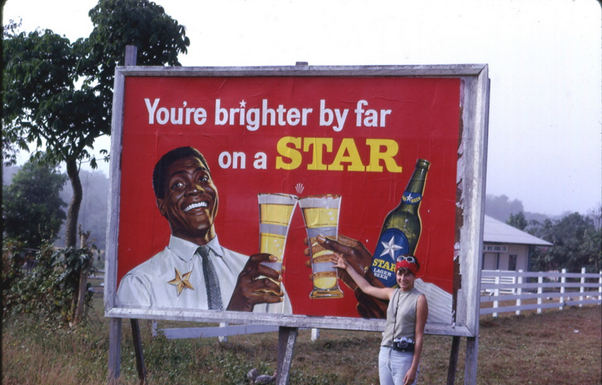
 Reclamebord Star in Africa
HEINEKEN IN AFRICA: THE MIRROR
The book Heineken in Afrika [i] has been called “the most valuable management book that I read in years” [ii], which is quite remarkable, since it wasn’t meant to be a management book. Research journalist Olivier van Beemen has worked for three years to write it. He visited 11 African countries where Heineken owns breweries. The result is this impressive description of 80 years Heineken on the African continent. It holds a large variety of fascinating stories, underpinned with quotes, figures and facts. All in all, the book creates a feeling of awe, of admiration mixed with aversion. Heineken has been able to become part of the local landscape. Yet it finds itself faced with a continuous stream of practical, economic, ethical and cultural challenges.
Loyalty
Heineken has perfectly understood that the African context calls for long term relationships and investments. When storms are raging all around them, whether there’s war, dictators or disease, Heineken tries to remain calm like a freshly tapped beer. They can take losses for years on end. This ability to endure, the display of loyalty, is very much appreciated in African culture. The brewing company is able to portray itself as part of the history and culture of several African countries. As such, it is even part of nation building, which is indeed necessary in post-colonial Africa. As a matter of course, this loyalty falls completely in line with economic rational, such as outsmarting the competition and the enormous profitability in the long run. The third largest brewer in the world makes 21% of its worldwide profit on the continent, while selling only 15% of all its beer.
The minefield of responsible entrepreneurship
Van Beemen describes long term relationships between the company and local business leaders, presidents and dictators, who either relax a tax bill or smooth out a licensing process for new-to-build breweries. By doing so, Heineken follows the intercultural teaching: in a collectivist society, relationship goes over task; so establish relationships first before you’re able to do business [iii]. If those relationships are with high level people, who would refuse? At what stage does a ruler turn into a dictator? At what stage is a present culturally necessary and at what stage do you contribute to corruption? Once the conventional cultural values at home do not apply, once government is weak in setting the limits, it becomes a real challenge to walk the minefield of responsible entrepreneurship. What is the corporate culture one wants to strife for and what else, besides economic rational, will steer strategic decision making?
Code of conduct
The same is true for the advertisements (and even symposia), in which Heineken explains the healthy impact of beer to its African audience. In doing so, the company breaches its own code of conduct, according to Van Beemen. Yet the code of conduct is written in a different context all together. Surely more aspects do not apply in Africa (or elsewhere). In the end, certain things are done the Dutch way, others are done the Nigerian/ Tunisian/ Congolese (etc.) way. It becomes a continuous balancing act between contradictory cultural norms and values. Lawlessness and sarcasm are just around the corner.
There are more disturbing stories. The story on tax evasion and the Belgian subsidiary Ibecor has evoked questions in both Dutch and European parliaments. The fact that Heineken alone generates 30% of the tax income of a country like Burundi is frightening. This level of influence calls for responsibility outside the usual realm of a company. In this respect the Professor of International Business Rob van Tulder [iv]wonders how on earth Heineken is able to be proud of the fact that it continued brewing during the genocide in this country.
Kalashnikov
The funniest yet most chilling conversation in the book is a telephone conversation from 1993. The (then) Director Africa in Amsterdam gets a phone call by their Belgian top manager in Burundi:
“I have an officer standing at my desk, asking to use the refrigerated storage room for soft drinks… <silence> … to store the body of the passed away president.”
“That doesn’t sound like a very good idea.”
“He has a Kalashnikov.”
“We can’t argue with a Kalashnikov. Try to prevent the funeral march from starting off at the brewery.” (p. 224/225).
Damage control
Back to 2016. Africa is changing rapidly and Heineken is doing damage control. Officially it has hardly commented on the book, apart from mentioning that it is convinced its presence in Africa has a positive and stabilizing impact. This may definitely be true in certain cases and at least may have been part of the intention in others. Van Beemen also didn’t set off on a crusade against Heineken. He only wanted to show that “doing business according to Western norms and values is not possible on a continent like Africa”. This is stating the obvious to interculturalists, yet indeed it’s often forgotten. For a company it is hard to explain to outsiders without damaging the brand image.
Mirror
So naturally, Heineken is doing damage control. But after the smoke has cleared, what’s left is a clear mirror that Van Beemen has been able to piece together. By doing this research, collecting all these stories from many different countries and bringing them together in a very readable statement, Van Beemen has given Heineken (and other multinationals for that matter) an excellent opportunity. Based on the book, Van Tulder advices Heineken to “think some things over”. In fact, it’s a superb chance to look at the image that emerges, sharpen the moral compass and decide where it wants to go from here.
[i] Beemen, Olivier van (2015). Heineken in Afrika. Prometheus, Vlaardingen.
[ii] Managementboek.nl
[iii] Hofstede, Hofstede & Minkov (2010). Cultures and Organizations, software of the mind, 3rd edition. McGraw Hill, USA.
[iv] Rob van Tulder, Professor of International Business-Society Management, Erasmus University Rotterdam. Symposium on ‘Heineken in Afrika’ in Pakhuis de Zwijger (Amsterdam), 11 July 2016 https://dezwijger.nl/programma/heineken-in-afrika/
“Heineken in Africa: the mirror” is an article that was posted on LinkedIn about the book ‘Heineken in Afrika’. More information on intercultural management in emerging markets: alette.vonk@cultural-insights.nl.